The Vanzylsrus vulture geoglyph - "Project manager's" perspective.
A reflection by Pieter Pienaar

If one is honest with oneself, the knowledge that one’s own understanding is limited will register somewhere on an internal mental screen. Fortunately, there is always reality that will land in your hands, like limestone rocks, supplementing insight limitations with hard experience. Sorry for this heavy introduction. Maybe I should just start at the beginning, but I’ll try to keep it concise, otherwise it becomes a short story.
You can call me a concerned or even a frustrated semi-retired art teacher; the absence of the arts in the Northern Cape remains a headache for me which causes me to dream – and it is a self-imposed “passion”; my own fault. To try and rectify this dire state of affairs, I came up with the idea in 2025 that Vanzylsrus, almost the last outpost, should have an arts week; the arts needed to come closer.

I used all the social media channels at my disposal
and posted many videos, begging people
to consider an art visit to Vanzylsrus.
One after another, I met the artists, writers,
and poets of the area and further afield,
and thus, a network of cheerful, upbeat,
and productive “warriors” was formed who wanted
to venture with me under this arts flag.
So where does the geoglyph fit in now? My artist friend,
Jan van der Merwe, the well-known
South African installation artist,
who has a wonderful gift for connecting artists,
passed our arts week idea on to the Site_Specific Collective.
The South African land art sibling-team,
Anni Snyman and her brother, PC Janse van Rensburg, contacted me.
I then asked around and they quickly found a piece of land
near Vanzylsrus, which belongs to the hotel owners.
Now the team of land art artists
could realise their dream of creating
their grand geoglyph, a vulture, with 17 000 limestone rocks.
(In the meantime, this number has doubled, as you will discover.)

The creation of the geoglyph became
the introduction to the 2025 Vanzylsrus arts week.
A week before the arts week was to start,
the 3,2km-long design of the vulture was drawn
by the experienced designers
and their local and international friends.
One couple even came from France to assist.

I then inherited the role
of “geoglyph project manager”.
My job was to get things in order
before the team would arrive
at the end of September 2025.
Thousands of limestone rocks
had to be collected and dumped on the site,
and I had to get three large
manganese rocks from a friendly
mine somewhere.
It is a good thing that one does not know
what a task truly entails, but one learns.
Fortunately, there was Kobus
Duvenhage Builders from Upington,
who were very excited about the geoglyph,
and they made a truck and a driver available
so we could transport the rocks. Kobus hails from Vanzylsrus and he also made arrangements
with the land surveyor, YXZ Resources,
who had to indicate the key points
of the geoglyph for the land art team.

A local farmer, Jaap Schreuder, also gathered
a few of his friends who helped gathering the rocks
and they took care of certain funding aspects too.
Early in September 2025,
Trollope Mining Mokala Manganese,
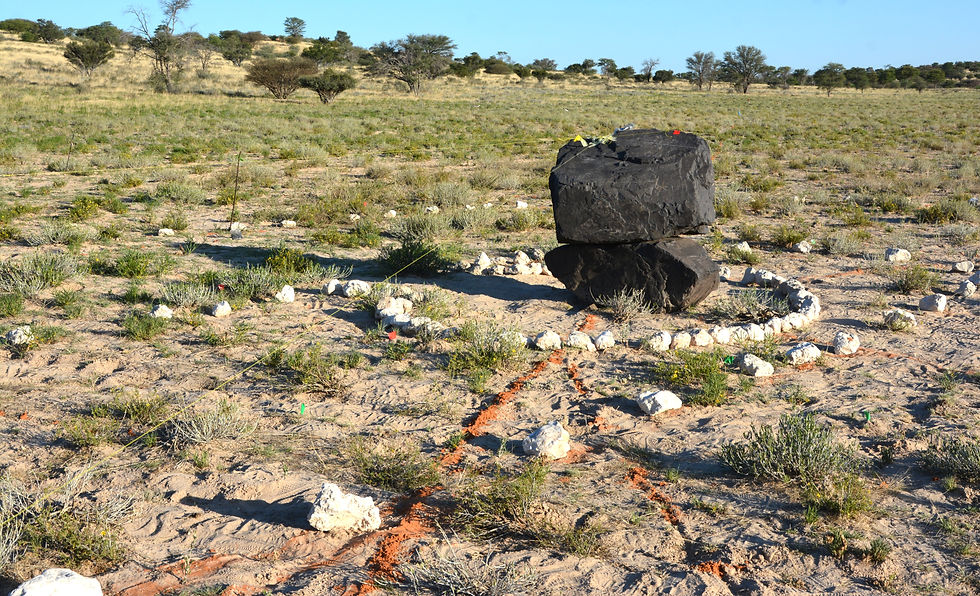
delivered 3 large manganese boulders to the geoglyph site
with their large crane truck.
The experienced operator lowered the boulders nicely
on the exact spots the land surveyors indicated,
and then gratitude flowed from my heart like a fountain.
These boulders would indicate
the eye and the claws of the vulture respectively.

As an art teacher I discussed land art as a genre
for many years in the art room, but I hardly ever used
the word geoglyph myself.
In my classes I did mention Strijdom van der Merwe,
Robert Smithson and perhaps
I also touched on Andy Goldsworthy,
but I never imagined that I would literally
be picking up stones,
be seen pushing them with a wheelbarrow,
and be participating in such an enormous land art project.
It was certainly not part
of my bucket list.

Besides all the practical implications
of such a huge project, there were of course also the
communication or negotiation aspects,
which I as an experienced teacher could certainly handle,
but there were quite a few flops here and there.
Thus, I apparently began unknowingly to do the work
of an entire team of “promoters”;
my art friends made me aware of it
as we reached the end of the first stage of the geoglyph.
There certainly had never been a geoglyph team
in the Kalahari before,
which could have shown me the ropes.

I had to make and send every video
and advertisement myself.
The thousands of limestone rocks that lay quietly
waiting along the road for
the stone-pickers and myself,
rose like a white mountain in my mind’s eye.
I think in my search for direction and information
I made half the country go crazy.
Please do not think
I am trying to say I am so smart.
What I want to convey is that the whole fuss
to get things done
was actually quite odd or extremely funny.
A team around me might have confused me even more.

How do you tell someone
in the Kalahari
that you are collecting
17 000 limestone rocks,
so that an outline
of a vulture can be drawn
on a plain with them.
It can only be seen from the air
by drone or aeroplane
– doesn’t it sound a bit much?
I think it might be
a little absurd
in a region
where the arts are
completely invisible.
Here and there you still hear,
“But there is nothing to see from the road.”
It is now almost like the story
of the emperor with no clothes for some people.

Well, urgent matters teach us to pray,
and emails and cell phones make it possible
to talk with mining managers and
respected community leaders.
So, amidst everything I become a bit anxious,
because there is a need for funding.
I send humble funding requests, beg and tell,
but not much happens.
One friend of mine who is a dentist in England
did send us a donation.
I learned among other things that for every 30 emails
you send you can expect 1 reply.
Because this project felt to me like
the construction of an Egyptian pyramid,
I wanted everyone to know,
photographers, the media, magazines
and probably the whole world.
When I consider everything that I tried
and I compare it with the poor yield
(which may be ungrateful too),
then I realize that I know very little,
but we managed to wave the arts flag.
I must just add a little side note here:
The local Northern Cape newspapers
and Novus Media did a splendid job
to boost our geoglyph cause –
and I kept them informed!

Of course, I also contacted
numerous government departments
and other institutions that might resonate
with the geoglyph, but alas, there was no reply.
Meanwhile, questions began to arise in my own mind,
in my attempt to understand,
why I felt that I could not really
make much progress
in conveying the message
effectively to the people,
I thought mattered.
I comforted myself with the idea that perhaps the term geoglyph must have been so strange
in a country where boom-boom music and beer tents
are actually for many the better
or even the best cultural option.
In the same breath, I must also add that the geoglyph
did indeed begin to overshadow the arts week,
but I was not worried about it at all.
It became clear that the enormous
scale of the project
had captured people's imaginations.
Perhaps this geoglyph
was sent from heaven
for me and the other “arts fighters”,
so that our attempt
to make hearts beat for the arts
in the Northern Cape platteland,
could gain some momentum
or at least tangible stature.
Only the future will reveal
the true facts and the state of affairs.

The geoglyph was “completed” in
September 2025 or that was the plan.
Tim Vinck from
the International Meerkat Research Station,
25km outside Vanzylsrus,
came to take the final drone photos
and the evidence did not look good.
The designers were not satisfied;
the existing line had to be widened.
We plan to do this from 1 – 10 May 2026.
I did not immediately realise
what the second line would entail
and I went to visit my friends at the coast
to celebrate the first successful
Vanzylsrus arts week.

When I was back in the Kalahari,
I realised that another 10 000
or more limestone rocks will have to be picked up.
When you walk next to the truck in the heat
and you cast the rocks
one by one onto the truck bed, it feels like a military operation.
We decided to do it in March 2026,
because April is Easter time
and there are quite a number of long weekends.
Kobus Duvenhage made his truck available
during the week of 9 to 13 March
and we “rocked and rolled”.
Jaap Schreuder and Dirk Burger assisted me.
The larger rocks on the site were also chiseled
into pieces with a jackhammer.

The noise is earsplitting as the compressor fires
up the jackhammers and I realise
with every stone that is broken and moved,
that I am completely out of my comfort zone,
but hope starts to lift my spirit,
and my discomfort is slowly replaced
with a vision of the completed geoglyph.
When the task is done,
the geoglyph will make its appearance,
with or without the involvement
of the local or wider community
and it will definitely serve a purpose.
I think, there surely comes a stage in every
project manager's struggle
with a project that the need for acceptance
and understanding fades
and the desire to reach the finish line,
becomes the focus.
You just want to mutter “amen”.

To solve the funding problem,
we decided to host a geoglyph festival
at Vanzylsrus on 9 May.
If you are sporty, you can come walk, jog or cycle.
The church organ has also been repaired for
an organ recital just before lunch
and a festival orchestra
from Johannesburg will come
to celebrate the appearance of the geoglyph,
around dusk.
We thought it was a splendid plan, but then
the Iran war erupted and now we wonder
where our little festival fits into
the gloomy petroleum picture.
Will people still be willing to pay for their tickets
and the extra diesel or petrol in order
to participate and do
something for the platteland?
During the time frame,
October 2025 to the end of February 2026,
which are the hottest months in the Kalahari,
I learned a lot from my
Kalahari friends and other arts and tourism enthusiasts.
The people of the Red Dune Route,
who do a lot to promote the Kalahari region
near the Kgalagadi Transfrontier Park,
told me they thought
we had run out of money and that
was why the geoglyph was still incomplete.
They were relieved when I reminded them
that no one can work on that plain
in the summer heat.
I also learned that a faculty called,
Creative Economy,
will be established at one of
our South African universities.
I then inhaled more hope and drive.
We are stimulating the creative economy
of the platteland
by completing this geoglyph
community project.
We had reason to continue our good work.

As a native of this region, it is difficult for me to see
how helpless and forgotten
many people in the platteland are.
I also experienced this daily firsthand when
we worked with the stone pickers
during March 2026.
The Site_Specific Collective
team leaders
sent money to pay the day laborers.
Every morning, we hired 6 workers
and there were always
too many who wanted to work,
because work is very scarce in these regions.
Some of the dear and friendly day laborers are addicted
to alcohol and you know, as you pay them,
that the money may not be spent on food.
There are also other day laborers
who are young and strong
with sober habits, but for them too,
the platteland does not predict a good future.
Let me conclude.
When the geoglyph is completed,
it will be registered as a landmark on Google Earth.
The plan is to train local tour guides
who could walk
with tourists around the geoglyph,
the guides will be paid,
and a percentage will also be given
to vulture conservation.

The vulture geoglyph will be a defined area,
due to the limestone outline
– which we think may consist
of approximately 38 000 stones.
It could also become a unique
one-day outdoor school.
On this site, the focus can be
on insects, reptiles, plants, birds,
and other ecosystem aspects.
Schools can send groups who can,
for example,
spend one night in a tent village
where they can learn about the stars,
and the next day they get to know
the natural elements of the geoglyph.
Of course, there is still a lot
that needs to happen
before everything will run smoothly,
but who would have thought that the arts
are able to deliver
such credible dividends in the platteland?
Bring back the arts!


Comments